Instead of Fleeing PC, Sony Should Have Built a Day-One PlayStation Storefront
By lyndonguitar
Published on May 20, 2026 write-up
 PlayTested
 Scan to read
full review
full review
PlayTested Ask this review
AI answers drawn only from this article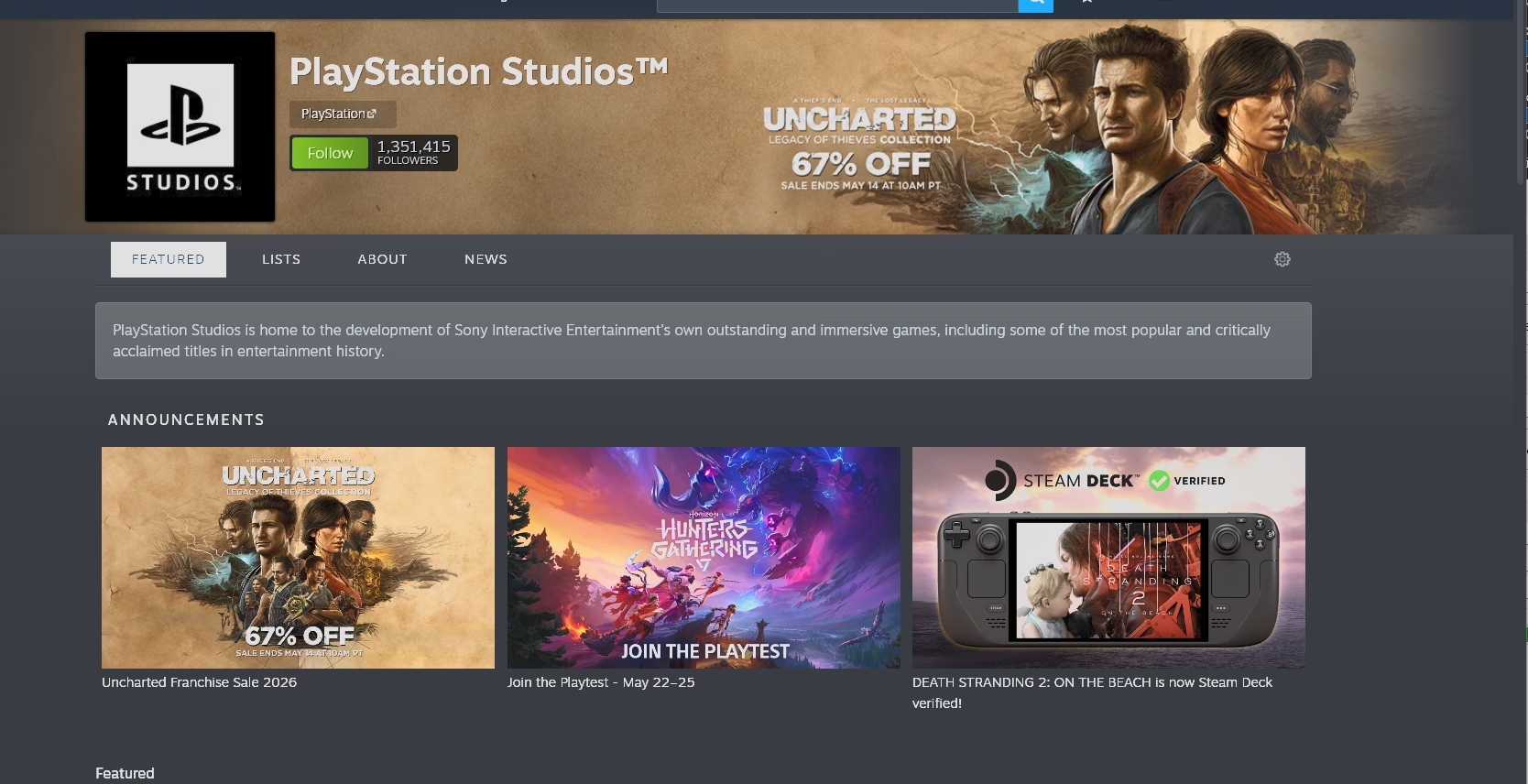 1 / 2
1 / 2If you’ve been enjoying the trend of playing major PlayStation hits on your PC rig, the party is officially winding down.
According to Bloomberg’s Jason Schreier, PlayStation is drastically shifting gears. Moving forward, their massive, single-player blockbusters—like Ghost of Yōtei and Marvel’s Wolverine—are staying locked to the PS5. While multiplayer games like Marathon will still hit PC to keep player counts healthy, Sony is drawing a hard line around their narrative adventures.
On the surface, it looks like Sony is just protecting console hardware. But look closer at the industry landscape, and the truth is much more frustrating: Sony is treating a self-inflicted wound like a platform problem. They should have just built their own storefront when they had the chance.
Sony’s biggest complaint is that recent PC ports underperformed. But honestly, what did they expect?
By making PC an afterthought, Sony choked out their own sales. By the time a port finally arrived at full price, the global marketing hype had completely died down, the story was thoroughly spoiled across social media, and the most impatient fans had already broken down and bought a PS5. Of course the ports underperformed—they were engineered to do so.
Instead of fixing the release window, Sony’s board room misread the data, blamed the PC market, and decided to take their ball and go home.
When Sony first dipped its toes into PC, it treated Steam and Epic like a low-risk dumping ground for older games. But relying entirely on third-party storefronts meant handing over a massive 30% cut of every digital sale to Valve.
For a company used to keeping 100% of first-party revenue on the PlayStation Network, writing a massive check to Gabe Newell every month was always going to cause corporate friction. When you add the soaring costs of high-tier PC port optimization and localized QA, those profit margins start shrinking fast.
Instead of crying foul over shrinking margins and pulling the plug, Sony should have built a native, standalone PlayStation Storefront on PC years ago.
If they had launched a proprietary launcher and made their marquee titles completely exclusive to it on day one, PC players would have willingly downloaded it to play games like Wolverine on launch day. Sony would have bypassed the 30% middleman tax entirely, secured a direct pipeline to the consumer, and made the PC ecosystem wildly profitable. Bonus points if they actually introduce cross-buy (like Xbox’s Play Anywhere program), that would actually make the storefront even more enticing, and would benefit PlayStation users to jump across PC and PlayStation frequently.
Failing to build that storefront infrastructure didn’t just hurt Sony’s margins; it walked them straight into a massive strategic corner. By surrendering their games entirely to Steam, Sony effectively allowed other hardware manufacturers to potentially turn PlayStation exclusives into their own system sellers.
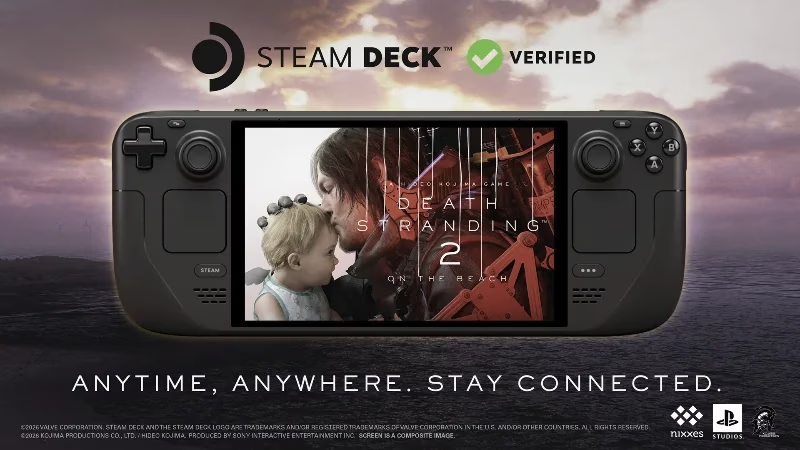
Look no further than Valve’s Steam Deck. Because Sony put God of War and Ghost of Tsushima on Steam, Valve was able to market their handheld as a device capable of playing premier PlayStation blockbusters on the go. Sony essentially did the heavy lifting of game development only to hand Valve a killer app for their hardware.
And the nightmare gets worse when looking at Microsoft. Xbox’s upcoming next-generation console, Project Helix, is fundamentally a Windows-powered PC/Console hybrid designed to run native PC storefronts like Steam out of the box. Because Sony chose to sell their games on Steam instead of building a secure, proprietary firewall launcher, a player could soon buy the next Xbox, boot up Steam, and play PlayStation exclusives on Microsoft hardware.
By relying on Steam instead of building their own ecosystem, Sony accidentally turned their greatest first-party weapons into future Xbox and Steam software.
Granted, if Microsoft’s next machine is truly an open PC hybrid, determined users would eventually have found a way to sidestep restrictions and install the hypothetical native PlayStation storefront with a few desktop tricks anyway. But by having absolutely no storefront of their own, Sony didn’t even force competitors to use a workaround—they just left the front door wide open.
To try and fix their ecosystem problem without spending real money, Sony tried pushing mandatory PlayStation Network (PSN) account linking on Steam. But forcing a console login onto a storefront you don’t even own was a clumsy, halfway measure that only succeeded in annoying PC players without fixing the underlying financial or platform-sharing issues.
Building a real digital storefront—handling global server architecture, payment backends, and million-user launch day traffic—requires a massive, long-term infrastructure investment. Sony simply wasn’t ready or willing to spend that money.
Instead of taking the risk to build a dominant, independent PlayStation ecosystem on PC, Sony is taking the safest, most risk-averse exit ramp possible. They are retreating back to the walled garden of the PS5 to protect hardware sales. It’s an understandable defensive play, but it stands as a massive missed opportunity to reshape the PC market on their own terms before the lines between PC and console blurred forever.
PlayTested 
Baldur's Gate 3, an epic RPG developed by Larian Studios and building on the legacy of the iconic Baldur's Gate series, was released in early access in 2020 and was met with an overwhelmingly positive response, reinvigorating interest in D&D-based video games. Larian Studios embraced the complexities of D&D's 5th Edition, creating a game that felt akin to playing the tabletop version virtually, for better and for worse. The vast world, intricate systems, and captivating storytelling that come with the experience of D&D are promised, resonating with long-time fans and newcomers alike.

Final Fantasy XVI delivers a dark, complex story far removed from nostalgia, with strong cinematic action, a dynamic combat system that grows over time, and impressive medieval-themed visuals.
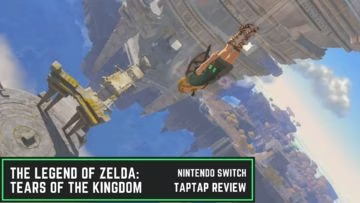
The Legend of Zelda: Tears of the Kingdom is an action-adventure game and the much awaited sequel to 2017’s award-winning game The Legend of Zelda: Breath of the Wild, boasting the same core gameplay mechanics including open world exploration and a non-linear story.
PlayTested AI
Answers from our reviews
Comments